Reimagining The Rules of Imagination
AI is not a creative threat; it’s a creative catalyst.

There’s a common misconception that artificial intelligence (AI) will replace human creativity. But at Jan Kelley, we have a different POV:
AI is not a creative threat; it’s a creative catalyst.
At the intersection of artificial intelligence and human imagination lies a transformative synergy that is redefining the very essence of innovation, design, and storytelling. Many fear that AI might replace creative roles. At Jan Kelley, we view AI not as a replacement but as an enhancer of human creativity, freeing talent to focus on areas uniquely suited to human expertise: strategic insights, emotional intelligence, and innovative thinking. AI tools such as Midjourney, Runway, Veo3, ChatGPT and Sora are propelling creativity to new heights, expanding boundaries rather than constraining them. Indeed, AI has become an indispensable creative partner, complementing human intuition with data-driven intelligence.
Creativity isn’t dead. It’s evolving.
This is the essence of Humanology – our philosophy that powerful marketing emerges at the intersection of human insights and technological innovation.
And now, that means embracing AI as a creative partner.
Expanding Ideation: AI as a Collaborative Partner.
Creativity begins with ideation to spark ideas that capture imagination, solve problems, and resonate with audiences. Traditionally, we brainstorm to expand our thinking and generate a volume of ideas. We then contract down to the strongest ones. This process is made exponentially larger with AI’s expansive toolset. AI enables us to gain richer understanding of our audience and leads us in directions we may not have previously explored.
In the Journal of Interactive Marketing, Margherita Pagani and Yorum Wind recently introduced a framework for AI-enabled creativity: (1) inspiring agile methods, (2) augmenting human creativity, and (3) inspiring unconventional thinking aimed at equipping marketing leaders with a deeper comprehension of AI’s creative potential.
Design Reimagined: AI-Driven Innovation
In the realm of visual design, AI tools are revolutionizing how we approach creative execution. Adobe’s Creative Suite has integrated AI generative tools to help enable creativity throughout the design process. From, Adobe Firefly being embedded directly within Adobe Stock, through to generative fill capabilities seamlessly built into Adobe Photoshop. This enables users to generate striking visuals and iterate designs rapidly, fostering experimentation and continuous refinement. These tools don’t constrain creativity; they amplify designers’ abilities, letting their imaginations run more freely and effectively (TechRadar, 2024).
Similarly, Figma’s AI-driven enhancements, including Figma Make and Buzz, have streamlined the design workflow. These innovations empower creatives by accelerating the prototyping process, reducing friction, and promoting more fluid collaboration across teams. Figma’s advancements illustrate how AI is facilitating creative growth through ease of use and intelligent, context-aware suggestions (The Verge, 2025).
Canva’s Magic Studio (named one of the best inventions of 2024 by Time) unlocks possibilities for non-designers. This AI-powered platform allows non-designers to effortlessly create visual content, significantly expanding creative accessibility and inclusivity.
In addition to design tools, we have access to a variety of tools to support content development. ChatGPT, Jasper, and Copy.ai are leading AI-powered content generation tools, each with a distinct edge. ChatGPT is a highly versatile conversational model capable of generating human-like text across a wide range of contexts, ideal for dialogue, creative writing, and ideation. Jasper focuses specifically on marketing and branded content, offering pre-built templates and tone-of-voice consistency for businesses looking to generate blog posts, ads, and website copy efficiently. Meanwhile, Copy.ai leans heavily into automation and scalability, enabling users to quickly create a variety of short-form content like social media captions, product descriptions, and emails with minimal input. While all three leverage generative AI, ChatGPT excels in depth and adaptability, Jasper in brand alignment, and Copy.ai in speed and ease for marketing teams.
Here’s a fun example of how AI helped us bring Jan to life. We used Runway, Midjourney to create our AI avatar with their image generation, motion capture and animation tools. And we generated an AI voice through ElevenLabs.

AI and the Art of Storytelling
Storytelling (perhaps the most human form of expression) is also benefiting profoundly from AI’s creative augmentation. Generative AI enables marketers to craft personalized, immersive narratives that forge deeper emotional connections with consumers. According to recent scholarly research, generative AI-driven storytelling represents a new era in marketing, leveraging powerful machine learning algorithms to produce nuanced and resonant stories that human creators might not conceive independently (Arxiv, 2023).
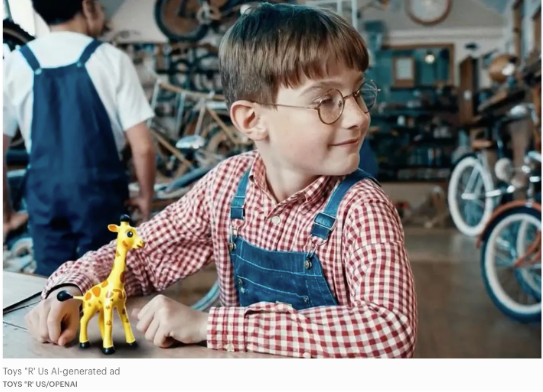
A compelling real-world application can be found in Toys “R” Us’s recent AI-generated brand film. Created using OpenAI’s Sora, the nostalgic yet innovative film captivated audiences by seamlessly blending historical visuals with contemporary narrative elements. This project demonstrates how AI tools can be harnessed to create compelling storytelling experiences that resonate deeply with consumers, combining emotional appeal with cutting-edge technology (NY Post, 2024).
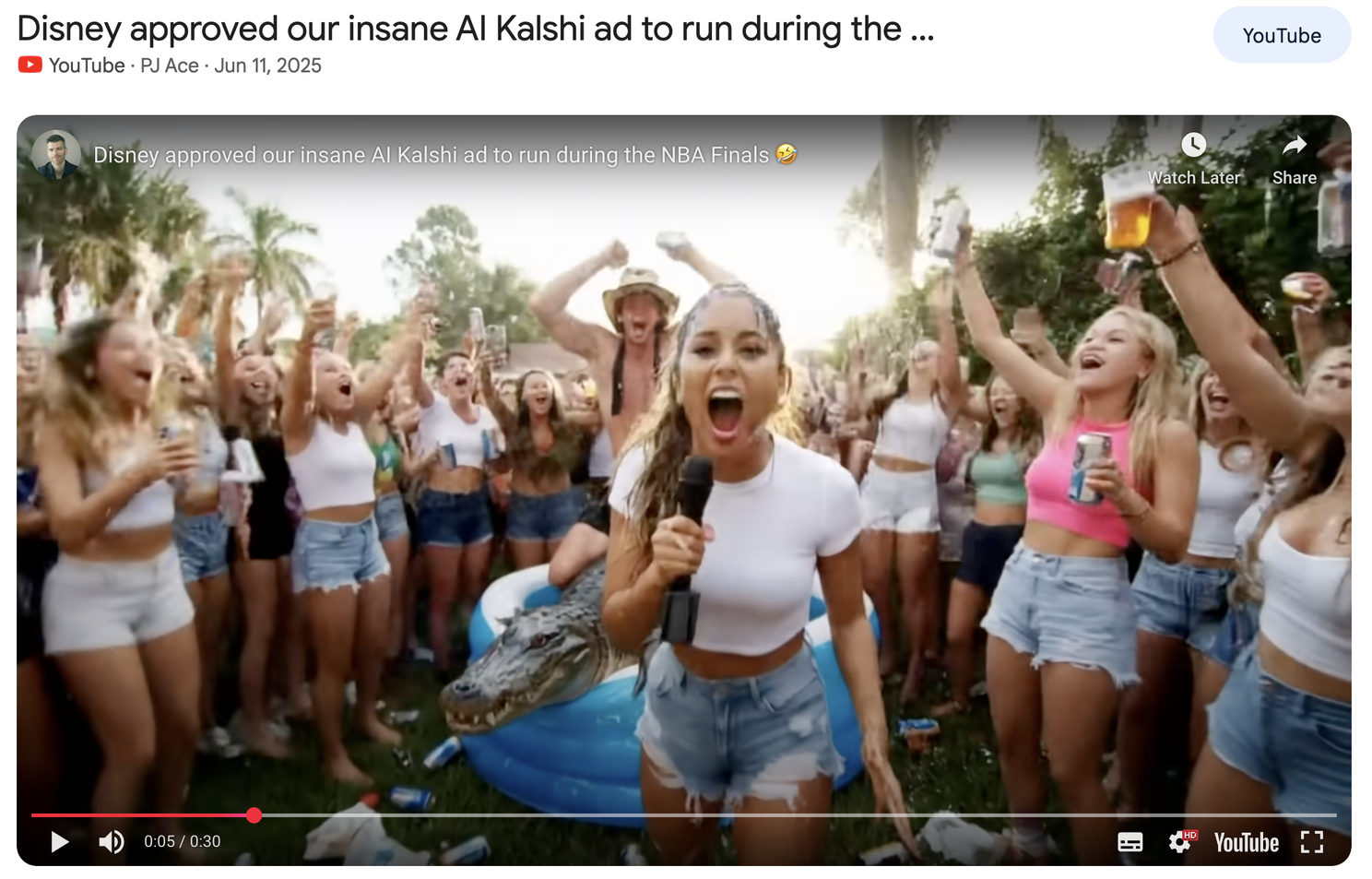
At the other end of spectrum is the zany Kalshi spot that aired during NBA finals and quickly went viral. The creative possibilities are endless.
Hedra’s AI-generated videos further prove this point. Using their advanced AI model, Character-3, Hedra enables content creators to produce emotionally expressive and hyper-realistic videos quickly and at scale, illustrating AI’s ability to amplify human creative outputs dramatically (Business Insider, 2025).

Meet Your New Creative Partner: Generative AI
While AI’s capabilities are powerful, the magic truly happens when AI tools work in concert with human intuition. Think of AI as a creative partner.
Research consistently supports the idea that creativity in marketing is enhanced significantly when AI is harnessed to complement, rather than replace, human insight (ResearchGate, 2024).
Studies show that human-AI teams produce more original and effective solutions to creative problems than either AI or humans alone. The research shows that while AI can surface a wide range of options quickly, human judgment is essential in selecting, refining, and shaping ideas that truly resonate with people.
At Jan Kelley, we see the integration of AI as a natural evolution of our creative philosophy.
It’s not about abandoning craft. It’s about elevating it with smarter tools and deeper insight.
Humanology focuses on the synergy between human creativity and AI augmentation, emphasizing that the most powerful and resonant work emerges from collaboration rather than isolation.
AI is not the enemy of creativity—it’s a powerful new partner.
It accelerates ideation, enhances design capabilities, and deepens storytelling, pushing creative possibilities further than ever before. Creativity is indeed alive and thriving, entering a new chapter of unprecedented innovation. Embrace the partnership, and watch your ideas soar.
A Call to Action: Let’s Create the Future
If you’re a marketer, this is your moment. The age of AI x Creativity isn’t a future scenario. It’s here. The only question is how you choose to engage with it.
The best ideas still come from human minds—but now, they come faster, go further, and make a bigger impact than ever before. Let’s stop fearing what AI might take away, and start imagining what it can help us create.
Here are 3 practical steps toward integrating AI in your creative:
#1. Audit your current creative processes to identify AI integration opportunities
Audit your current creative processes to identify AI integration opportunities.
#2. Pilot small-scale projects using AI-generated content to test effectiveness
Pilot small-scale projects using AI-generated content to test effectiveness.
#3. Iteratively scale successful pilots to broader marketing initiatives
Iteratively scale successful pilots to broader marketing initiatives.
Interested in exploring how Humanology can drive measurable creative results for your brand? Drop us a line or join the conversation on LinkedIn.
More Blog & Insights
 " alt="" loading="lazy" role="presentation" />
Automotive
Aftermarket Parts Manufacturers: How to Win Pull-Through by Owning Technicians and Platforms
Win the point of decision by mastering platform visibility and technician trust.
Read more " alt="" loading="lazy" role="presentation" />
Automotive
Not 1 but 3 Ways to Use Data to Your Advantage
3 ways to harness the power of data for more effective marketing.
Read more " alt="" loading="lazy" role="presentation" />
Automotive
Never miss another blog post
Want to sign up for updates, announcements, offers and promotions from Jan Kelley? Simply fill in the form below and we’ll keep you up to date. You may later withdraw your consent at any time. Check out our Privacy Policy.