Searching for More Powerful Human Insights? Start Here.
Marketers today need both creativity rooted in human insights AND technology that informs and then amplifies.

Marketers today need both creativity rooted in human insights AND technology that informs and then amplifies. By combining the brilliance of humanity with the most powerful digital technologies, we spark ideas, generate momentum, drive long-lasting growth and realize the true potential of a brand.
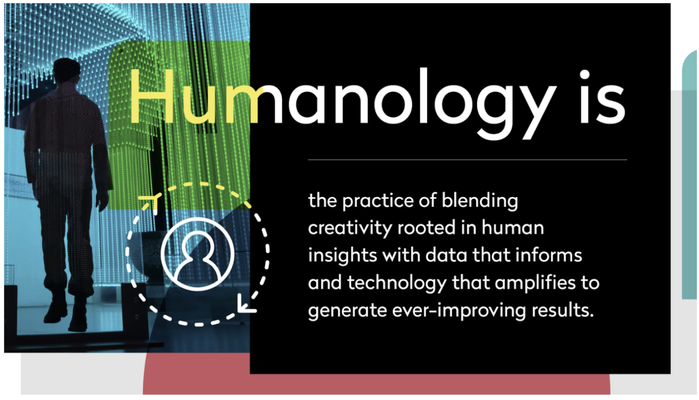
Humanology is Jan Kelley’s approach to marketing in a digital world.
Technology has enabled us to reach buyers with more precision, at more stages of a complex customer journey, faster and more accurately than ever before. It has also allowed us to transform marketing into a constantly evolving, rapidly innovating, fully immersive customer experience.
Yet the core of what makes marketing messages effective remains the same – human insights driven by deep understanding of human nature. Technology has evolved, but the power of ideas driven by human insights is as strong today as it ever was.
A true human insight is an in-depth understanding of consumers’ inherent desires, needs, behaviours and motivations. It’s more than just data; it’s about understanding the “why” behind the choices people make. Dove’s multi-year Real Beauty campaign is an excellent example of leveraging a powerful human insight. Why do people buy beauty products? For almost 20 years now, the company has recognized that when people buy beauty products, they are actually seeking self-esteem and self-acceptance.
So how do you identify rich, compelling human insights to inspire great ideas?
It starts with getting focused on customers and recognizing that data alone is not enough.
Get focused on customers.
We gain rich human insights by getting focused on people and by building a customer-obsessed culture grounded in curiosity and constant learning. This means focusing on identifying and solving customer problems and pain points. It also means putting your customers at the heart of every decision you make.
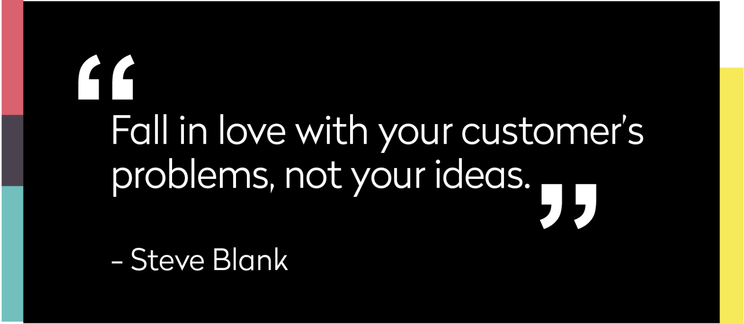
Steve Blank is an entrepreneur and author who co-created the Lean Startup movement.
A study by Forrester Research found that businesses that are customer obsessed are 60% more profitable compared to those that aren’t. These businesses don’t just listen to their customers—they anticipate needs, innovate around desires and consistently offer exceptional experiences.
Forrester’s The State Of Customer Obsession, 2023 survey shows that decision makers at customer-obsessed B2B companies are twice as likely as their non-customer-obsessed counterparts to report year-over-year revenue growth of 10% or more, and twice as likely to have year-over-year profitability growth of 10% or more.
Today, people and customer centricity isn’t just a strategy—it’s the bedrock for sustainable growth and differentiation. It fosters loyalty and propels creativity.
When you truly understand your customers, you can make decisions more effectively. You can tap into technology and innovative ideas to transform the customer experience. And you can delight people in a way that matters to them.
Recognize that data alone is not enough.
The essence of great marketing is understanding. People today expect more, and therefore we must understand them more deeply. To truly connect with an audience, marketers must go beyond surface-level observations and gain insights into human needs, motivations and behaviours. These are the insights that have the potential to inspire the most innovative and resonant marketing ideas.
We need to understand the “why” of what people do, and data alone doesn’t always deliver this. To gain a deeper understanding of “why people do what they do,” we often need to combine quantitative data points with qualitative research.
We start by gathering quantitative data that provides a broader view of behaviour patterns. This includes the obvious, such as:
- Competitive analysis to understand market standards, gaps and opportunities for differentiation;
- Customer feedback and reviews to understand experience and pain points;
- Third party platform tools: (i.e. Insights Finder on YouTube to find out what your audience is looking for on this platform)
- Sentiment analysis from social media listening tools to quantify emotions and attitudes towards a brand, product or service;
- Net Promoter Score (NPS) to gauge customer loyalty and identify areas of improvement;
- Heatmaps and session recordings (i.e. Hotjar or Crazy Egg) to understand user behaviour, track mouse movements and identify which areas of your site gain the most attention; and
- Usability testing to identify pain points in the user experience, ensuring the platform is intuitive.
We then use a variety of qualitative techniques to complement our data analytics.
Qualitative research allows us to dig deeper and address data blind spots. As the saying goes, “Not everything that can be counted counts, and not everything that counts can be counted.”
Here are a few techniques that allow us to dig for human insights behind the data by empathizing through observation and discovering through interaction:
#1. Stakeholder surveys: Direct feedback can help pinpoint pain points, preferences and satisfaction levels.
#2. In-depth interviews (IDIs): One-on-one interviews, when conducted with genuine curiosity and without a strict script, can lead to revelations about consumer needs, fears and aspirations. It’s about asking the right open-ended questions, going beyond surface-level responses and then truly listening.
#3. Collaborative stakeholder workshops: Involve various stakeholders, from customers to employees to partners. Workshops that employ brainstorming sessions, role playing and other interactive activities can be a treasure trove of insights. This can also include customer journey mapping, where we chart the journey a customer takes from the first point of contact to the final conversion to identify key touchpoints, potential drop-offs and opportunities for enhancement.
#4. Ethnographic research (the science of observation): This is a qualitative research method where researchers observe and/or interact with a study’s participants in their real-life environment. For marketers, it means stepping out of the office and into the homes, workplaces and communities of their target audience to obtain a deeper understanding of user behaviour, motivations and cultural influences.
#5. Immersion: Sometimes, to really understand your audience, you have to walk a mile in their shoes. Living the life of your consumer can bring about insights that would be impossible to gain from a distance.
Brands who are doing it right.
Glidden: We worked with Glidden to help the brand break through the overcrowded, super-competitive DIY market by capitalizing on two key insights: 1) DIY painting can be expensive, overwhelming and tiring, and 2) 20-something consumers crave simplification.
While direct competitors like Behr and Sherwin-Williams reach their audiences by using famous stars or aspirational rooms that real people don’t actually live in, we positioned Glidden as the paint company that isn’t afraid to tell the truth. Instead of glamourizing painting, we got dirty—literally. The Glidden “Let’s Be Real” campaign celebrates the tedious prep work of painting, the endless clashes over colour and the general crappiness of it all.
And, because Glidden has the best price for a gallon of paint, we didn’t shy away from talking about money. The ads feature frustrated or tired people, and couples arguing over paint colour or complaining about the cost.
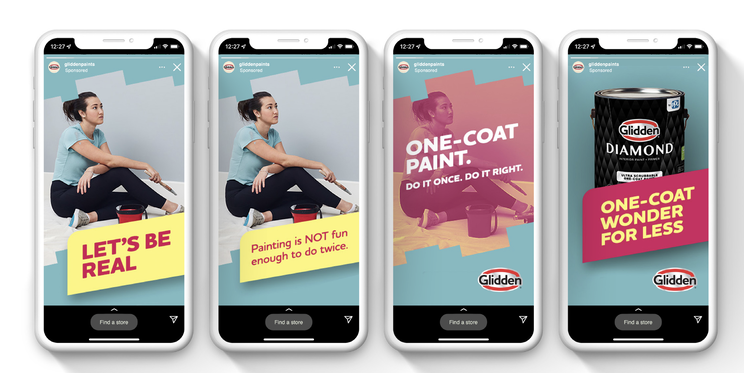
Glidden Let’s Be Real Campaign
The results speak for themselves. We learned pretty quickly that this honest, no-BS approach was the fresh take our younger DIY audience was craving. After fewer than three months in the market, the campaign pulled in 205M impressions, 333K clicks and a 96% viewability rate! Plus, we grew Glidden’s Facebook follower base by 7%. We also created a proprietary tool that helped us find new audiences for Glidden. Overall, it was a massive success. We didn’t just hit our aggressive targets – we surpassed them 20x over.
Volvo Trucks: This work fall into the category of work I wish we had done. In the world’s largest unboxing, Volvo Trucks taps into the insight that owner-operators and drivers love their trucks almost as much as kids love their toy trucks. It reminds us that we indeed can (and should) bring emotion and fun into B2B buying decisions

Volvo Trucks: World’s Largest Unboxing
By giving a 3-year-old truck enthusiast the surprise of a lifetime and by breaking a Guinness world record, the company was able to showcase the long-haul truck’s cutting-edge drivetrain technology, unparalleled safety systems and class-leading driver comfort.
So what does this all mean for marketers?
In the age of personalization, leveraging the above techniques to gain profound insights is crucial. They enable us as marketers to create campaigns that resonate, products that solve genuine problems and experiences that foster loyalty.
Remember, the goal is to understand not just what your target audiences and customers do, but also why they do it. Only then can you truly meet their needs and desires.
While digital platforms provide businesses with an unparalleled reach, the saturation of content and advertisements means that only the most original and creative ideas shine through. It’s about creating a narrative that resonates, engages and compels. And you need human insights to do this well.
Data remains a critically powerful tool in our marketing arsenal, but creativity fuelled by a customer focus and a devotion to human insights is the differentiator in the digital age.
It’s the combination of creativity and data, rather than the dominance of one over the other, that will drive the next wave of breakthroughs in digital marketing.
Thoughts? Suggestions? I’d love to hear from you.
More Blog & Insights
 " alt="" loading="lazy" role="presentation" />
Automotive
Reimagining The Rules of Imagination
AI is not a creative threat; it’s a creative catalyst.
Read more " alt="" loading="lazy" role="presentation" />
Automotive
Great Expectations & Opportunities
Blending creativity & technology is a must for leaders to achieve success in modern marketing.
Read more " alt="" loading="lazy" role="presentation" />
Insights
AI and Insights: It’s Time to Rethink How Decisions Are Made
AI accelerates pattern detection. Advantage comes from how decisions are owned and acted on.
Read moreNever miss another blog post
Want to sign up for updates, announcements, offers and promotions from Jan Kelley? Simply fill in the form below and we’ll keep you up to date. You may later withdraw your consent at any time. Check out our Privacy Policy.