The Future of Marketing: Reimagining Humanology with AI
“It’s not humans versus AI. It’s humans with AI.”
“It’s not humans versus AI. It’s humans with AI.”
It’s not a tagline. It’s the marketing imperative of our time.
In 2025, marketers stand at a pivotal inflection point. AI is no longer a futuristic idea. It’s embedded in the tools we use, the channels in which we operate, and in our customers’ expectations of us. While the headlines love a “humans vs. robots” narrative, the truth is more powerful and more hopeful:
Marketing is about to get more human, not less. More intuitive. More personal. More impactful. AI isn’t replacing us. It’s expanding us.
Why Does Humanology Matter Now?
At Jan Kelley, we have long called the convergence of human insight and intelligent technology Humanology. And with the rapid advancement of AI (read: AI tsunami), it’s the only viable path forward for modern marketing.
This isn’t just about efficiency. It’s about effectiveness. It’s about unlocking what the Journal of Marketing Analytics now calls hybrid intelligence, where machines do what machines do best (analyze, automate, optimize) while humans focus on storytelling, empathy, strategy, and brand building.
Humanology (Humans & AI) operates as a marketing flywheel, compounding impact by bringing together:
- Creativity – rooted in human insight
- Data – used to inform and validate direction
- Technology – used to scale, optimize and personalize
- AI – now, the glue that connects it all
Brands embracing this flywheel will build more agile, relevant, and meaningful customer experiences.
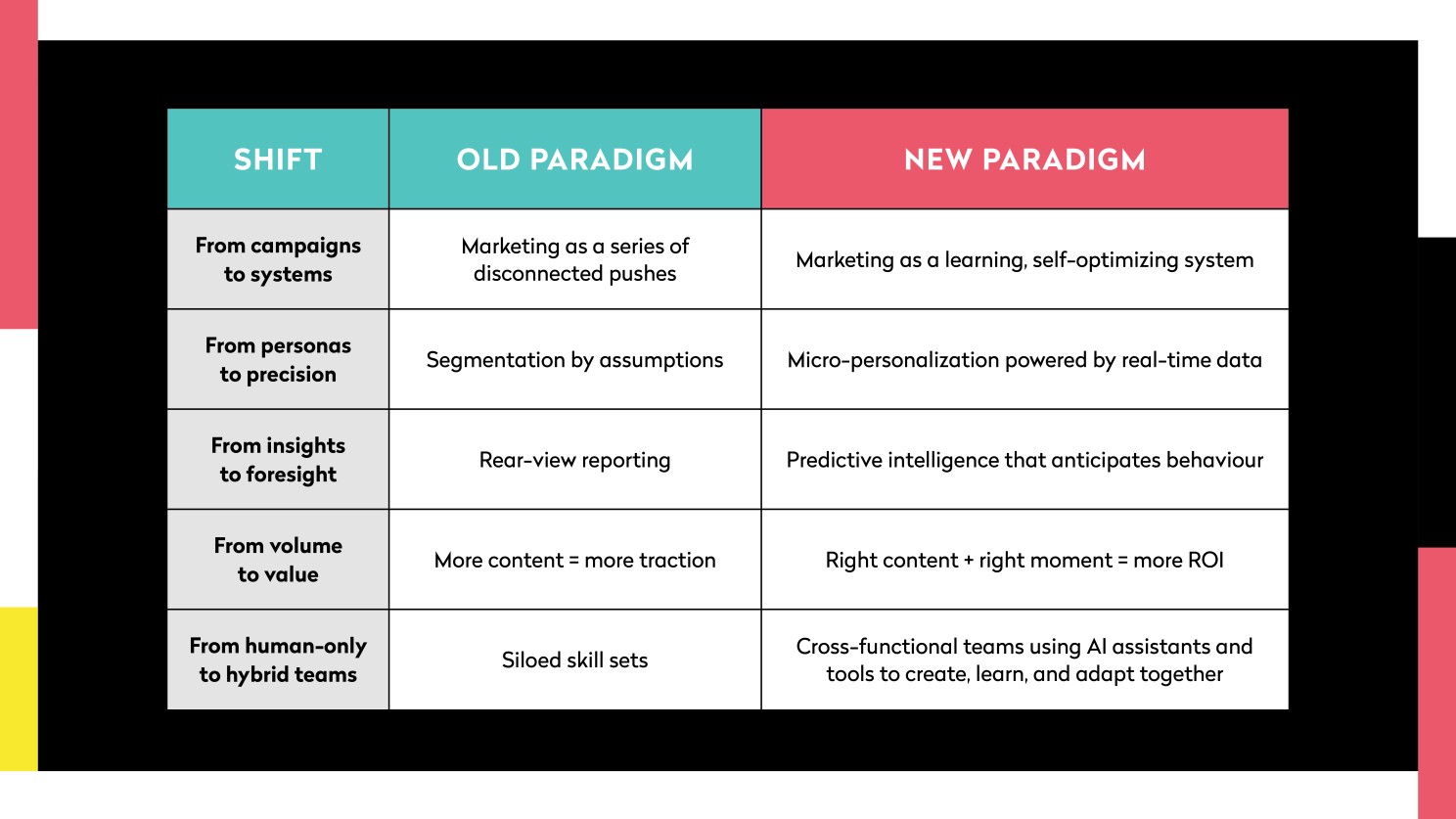
How Is AI Reshaping the Role of Marketing?
AI isn’t just speeding things up. It’s reshaping how we think about marketing altogether. Here are five fundamental shifts happening right now:
What Does “Humans With AI” Look Like?
Let’s break down what this collaboration looks like in practice:
#1. Strategy, Supercharged
AI models can analyze years of performance data in minutes, identify anomalies, prioritize opportunities, and even generate first-draft growth plans.
But humans are still essential to ask the right questions, align to brand purpose, and navigate complex trade-offs.
#2. Creative, Reimagined
AI tools like Adobe Firefly, Sora, and ChatGPT can create compelling drafts and spark unexpected ideas.
But originality, emotional resonance, and cultural nuance still require human storytellers to guide the output and set the tone.
It’s not about AI replacing the creative brief. It’s about AI helping you write a better one faster.
#3. Execution, Accelerated
AI-driven ad platforms (like Meta’s Advantage+, Google’s Performance Max) are making campaign optimization radically more automated.
But the creative input, testing structure, and success metrics still require human intention and oversight.

Let AI do the tedious, heavy lifting to supercharge your efforts.
What Does This Mean for Marketers?
The implications are massive and urgent. As AI becomes more embedded, marketers must retool their skillsets and reset their mindsets.
Here’s what forward-looking leaders are already doing:
- Building AI fluency across teams – not just hiring data scientists, but training everyone to understand and leverage AI tools.
- Reframing marketing roles – from content creator to content conductor, from analyst to insight orchestrator.
- Investing in proprietary data – because first-party data fuels smarter AI outputs, better personalization, and stronger competitive moats.
- Shifting from campaign calendars to growth sprints – where every touchpoint becomes a test, and learning cycles are compressed.
It’s about figuring out where AI augments and where it doesn’t. A comprehensive review published in Nature Human Behaviour analyzed over 100 studies on human–AI collaboration. The research concluded that combining human creativity and intuition with AI’s analytical capabilities leads to significant improvements in tasks involving content creation. However, the study also found that in decision-making tasks, human–AI teams did not consistently outperform the best individual (human or AI) performers.
How Is Jan Kelley Putting AI Into Action? Inside JKAI
We believe the future of marketing belongs to those who can harness the best of human ingenuity and artificial intelligence.
That’s why we created JKAI (Jan Kelley Artificial Intelligence). It isn’t a single tool, it’s a cross-functional system designed to integrate AI across every stage of the marketing value chain—from insights to execution. It’s how we’re turning the Humanology philosophy into practice every day. It evolves constantly, but today, our end-to-end AI-assisted workflow is made up of custom AI solutions and 40+ AI-enabled tools that make our teams smarter, faster and more informed.

Here’s how we’re embedding AI into our workflows and client solutions through JKAI:
#1. Smarter Strategy with Predictive Insights
We use AI-powered models to analyze client data, uncover audience signals, and forecast campaign performance. Whether we’re doing keyword clustering for SEO or competitive analysis to identify whitespace in the market, AI helps our strategists work smarter—and get to insights faster.
#2. Faster, Smarter Content Creation
Our creative and content teams use tools like DALL-E3, Midjourney, ChatGPT and Adobe Firefly to accelerate ideation, optimize messaging, and generate visual assets. But humans still set the brief, shape the story, and ensure the work is brand-right and audience-smart.
AI writes a first draft. We write the final word.
#3. Performance Media Optimization
In paid media, we use AI to automate bidding strategies, refine audience segmentation, and dynamically test creative variations. This results in greater precision, faster optimization cycles, and stronger ROI without sacrificing brand alignment.
#4. Enhanced Reporting & Analysis
JKAI is helping us reimagine how we deliver value in reporting. By automating routine dashboards and layering in generative analysis, we can now spend more time telling the story behind the data and recommending actions that matter.
Our Approach: Human-Led, AI-Enabled
JKAI is not about replacing people. It’s about freeing them to do their best work – focusing on the insight, creativity, and client understanding that machines can’t replicate.
Let’s Connect
Where are you on your Human & AI journey? How is your team experimenting with AI right now? What’s working? And what’s still fuzzy? We’d love to hear about your experiences.
Drop us a line or join the conversation on LinkedIn.
More Blog & Insights
 " alt="" loading="lazy" role="presentation" />
The Future
AI Can’t Fix Your Strategy. It Can Only Optimize What You’ve Already Decided
AI only amplifies your assumptions. If your positioning is unclear, your outputs will be too.
Read more " alt="" loading="lazy" role="presentation" />
Building Materials
Does Your Building Materials Brand Have a Place on TikTok?
See how building materials brands can jump on the TikTok bandwagon and connect with audiences in a new way.
Read more " alt="" loading="lazy" role="presentation" />
Building Materials
The Influencer Space Has Changed: Now There’s Something for Every Building Materials Brand
Our perspective on social media influencer marketing and how brands in the building materials industry can start envisioning their own program.
Read moreNever miss another blog post
Want to sign up for updates, announcements, offers and promotions from Jan Kelley? Simply fill in the form below and we’ll keep you up to date. You may later withdraw your consent at any time. Check out our Privacy Policy.