Winning B2B Marketing in 2026
B2B growth in 2026 will not be driven by better execution of the same playbooks. It will be driven by making clearer choices.

TL;DR 👇
In our earlier work on leading through change in 2026, we made a simple claim: volatility is no longer temporary. For B2B leaders, that volatility shows up as longer sales cycles, tighter scrutiny from buying committees, and more internal pressure to prove short-term impact.
The response most organizations default to is optimization. More dashboards. More content. More alignment meetings. That instinct is wrong.
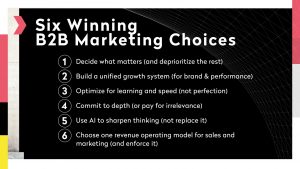
B2B marketing leaders who win in 2026 will make a few, hard strategic choices early on.
Here are the six that matter most.
#1. Decide what metrics matter (and deprioritize the rest)
B2B marketing is full of activity that looks productive and changes nothing. MQLs rise. Engagement scores spike. Pipeline quality stays flat.
Winning teams make an explicit decision about what progress actually means and eliminate everything else.
In B2B, real signal shows up in pipeline velocity by segment, win rate by deal size and buying group complexity, and stage conversion at the account level. Signal does not live in lead counts, content downloads, or channel engagement divorced from revenue.
The strongest teams measure how marketing changes sales behaviour. Are reps entering deals earlier? Are cycles shortening? Are fewer deals stalling in late stages?
If a metric does not change how you allocate accounts, budget, or sales effort, it is noise. Allowing noise trains teams to optimize activity instead of outcomes.
Eliminate noise to create the clarity needed to move quickly.
#2. Build a unified growth system (brand & performance)
The marketers who win the next decade will not be the ones with the strongest brand or the best performance engine in isolation. They will be the ones who integrate both into a single growth system.
B2B buyers do not experience brand and performance separately.They experience a single system working or breaking in real time. Brand creates confidence by setting direction and meaning. Performance turns that meaning into action by showing up consistently across channels, accounts, and moments that matter. Positioning anchors the system by defining where you compete and why you win.
When brand and performance operate together, momentum builds and conversion follows.
When they’re split, teams chase isolated wins, measurement fractures, and growth stalls. Full-funnel integration is how brand affinity turns into demand and demand turns into durable growth.
Winning leaders will design one system where brand guides demand creation, sales enablement, and expansion, and performance data sharpens brand decisions over time.
#3. Optimize for learning speed (not perfection)
Long sales cycles are often used to justify slow change. That logic confuses revenue lag with learning lag.
You may not see revenue impact for months, but you can learn from the market every week.
Adaptable organizations build modular messaging that flexes by industry, reallocate budget quarterly based on pipeline movement, and test enablement and account strategy even when product roadmaps are fixed.
Perfection delays learning. Learning compounds the advantage.
In 2026, marketing leaders who who win will be leaders who design systems where course correction is routine.
#4. Commit to depth (or pay for irrelevance)
Broad reach is expensive in B2B and rarely decisive. Depth wins because relevance moves buying committees.
Depth means committing to a narrow ICP and building disproportionate understanding of how those accounts buy, stall, and decide. It means knowing internal politics, not just use cases.
This is where many teams misuse account-based marketing. Personalization theatre is not depth. Logo swaps without insight do not change outcomes.
Real depth shows up as fewer target accounts with higher conviction, messaging that reflects internal risk, and serious investment in retention, expansion, and advocacy.
In 2026, relevance will beat scale in crowded categories.
#5. Use AI to sharpen thinking (not replace it)
AI will reshape B2B marketing, but misuse will destroy trust faster than it creates efficiency.
The quickest way to lose credibility with enterprise buyers is to flood the market with AI-generated content that sounds impressive and says nothing.
Winning teams will apply AI to synthesize account research, map buying committee, model pricing and packaging, and to accelerate strategic exploration.
They will stay disciplined with their downstream content. They will judge output by clarity, relevance, and usefulness to a real sales conversation.
In B2B, trust is fragile. AI that erodes signal or specificity hurts performance. Advantage accrues to teams that use AI to improve judgment.
#6. Choose one revenue operating model across sales and marketing (and enforce it)
This is the choice most B2B organizations avoid and the one that now matters most.
Many companies claim alignment while operating conflicting models. Marketing optimizes for pipeline creation. Sales optimizes for closed revenue. Ownership is blurry by design.
Winning organizations will choose one revenue operating model and enforce it. That means clear account ownership across the full lifecycle, shared definitions of pipeline quality and readiness, and joint accountability for priority accounts instead of handoffs.
Some teams organize around account pods. Others deal size or segment. Structure matters less than clarity.
When sales and marketing optimize for different outcomes, performance is negatively impacted. When they share one model, friction drops and learning accelerates.
Closing Thoughts: The B2B Advantage in 2026
None of these choices are easy. All of them require saying no.
B2B growth compounds slowly and punishes indecision harshly. The leaders who win in 2026 will not be the ones with the most tools, the biggest teams, or the loudest activity.
They will be the ones who make clear choices and build around them.
More Blog & Insights
 " alt="" loading="lazy" role="presentation" />
Automotive
Great Expectations & Opportunities
Blending creativity & technology is a must for leaders to achieve success in modern marketing.
Read more " alt="" loading="lazy" role="presentation" />
Building Materials
What You Risk When You Focus Solely on Lead Generation
There are risks when you focus your marketing efforts solely on lead generation. Learn what building materials brands can do to ensure lead gen success.
Read more " alt="" loading="lazy" role="presentation" />
The Future
AI Can’t Fix Your Strategy. It Can Only Optimize What You’ve Already Decided
AI only amplifies your assumptions. If your positioning is unclear, your outputs will be too.
Read moreNever miss another blog post
Want to sign up for updates, announcements, offers and promotions from Jan Kelley? Simply fill in the form below and we’ll keep you up to date. You may later withdraw your consent at any time. Check out our Privacy Policy.