From SEO to Search Everywhere
AI Is Defining Your Brand. Are You Letting It Get You Wrong?


A note before we dig in
Like many of you, we are uneasy about the rapid development of AI.
The concerns are much bigger than marketing. AI is changing how information is created, accessed, prioritized, and trusted. It raises real questions about bias, misinformation, privacy, intellectual property, creative ownership, labour disruption, environmental impact, concentration of power, and what happens when people rely too heavily on automated answers.
These concerns deserve scrutiny, regulation, public debate, and a more responsible pace of adoption.
At the same time, marketers do not get to sit this out.
We can hold the concern and still acknowledge that the shift is already here. Our brands are being interpreted by AI-generated answers, recommendation systems, social conversations, reviews, and third-party sources, whether we are actively shaping that interpretation or not.
So the job is not to chase AI blindly. Responsible marketing in this environment starts with visibility, accountability, and a clear understanding of how automated systems represent brands to the public.
Ignoring the shift does not slow it down. It only gives competitors and algorithms more room to define our brands for us.
Let’s dig in.
For years, the formula was straightforward. Improve your SEO. Increase your rankings. Drive more traffic. That model is no longer enough.
Many brands are losing influence before they even know buyers are considering them.
AI-generated summaries, answer engines, recommendation systems, Reddit threads, YouTube videos, reviews, and social platforms are increasingly shaping what buyers believe, who they trust, and which brands make the shortlist before anyone visits a website.
By the time a prospect reaches your site, the first impression may already be decided.
This creates a real competitive risk.
If AI misunderstands your brand, overlooks your expertise, or gives competitors more authority, you are not just losing traffic. You are losing influence at the point where choices are being made.
From SEO to Search Everywhere
Traditional SEO was designed to help brands rank high on Google and win visibility. That still matters, but it is no longer enough.
Search has expanded and fragmented: SEO helps people find you in traditional results. AEO helps you appear in direct answers. GEO helps AI systems understand, reference, and recommend your brand.
Each works differently, but they all depend on the same thing: authority that people can trust and that systems can recognize.
But SEO, AEO, and GEO are only part of the picture. The signals that shape visibility now come from a much wider ecosystem. That is why “Search Everywhere Strategy” matters. Brands need to show up wherever answers are being formed. This includes:
- Search engines
- AI assistants and large language models
- Social platforms
- Online communities
- Review sites
- Video platforms
- Industry publications
- Third-party sources that AI systems use to establish trust and authority
The goal is no longer just traffic. The goal is ensuring your brand is accurately understood, consistently represented, and recommended in places where decisions are taking shape.
The New Competitive Advantage: Decision Influence
Most organizations still think about content as a publishing exercise. They assume more articles, more posts, more keywords, and more assets will solve the problem. It won’t.
In the AI era, volume without authority creates noise. The brands that win will be the ones AI systems can understand, verify, and trust.
This requires a different operating model. Content, reputation, search, PR, social media, analytics, customer experience, and brand strategy all shape how AI understands a business.
To earn visibility and trust in this environment, a brand needs to focus on four things:
- AI understands the brand correctly.
- The organization is cited as a trusted source.
- The brand appears where AI systems gather signals.
- The narrative is reinforced consistently across channels.
That is why multi-channel authority matters.
For example, if your website says one thing, your reviews suggest another, your executives are absent from industry conversations, and third-party sources barely mention your expertise, AI has weak or conflicting signals to work with.
AI systems don’t only learn from your website. They pull signals from what others say about you, where you appear, how consistently your expertise is represented, and whether your brand is connected to the topics you claim to own.
No single discipline can accomplish this alone.
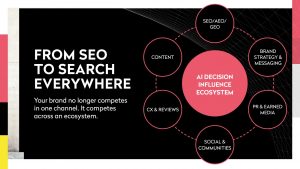
Why AI Visibility Is a Multidisciplinary Challenge
One of the biggest misconceptions about AI visibility is that it belongs solely to SEO teams. AI visibility does not live neatly inside one department:
SEO and analytics reveal search behaviour and visibility gaps.
Content creates the structured knowledge AI can interpret.
PR builds third-party authority.
Social and community shape the conversations AI increasingly learns from.
Brand strategy keeps the story consistent.
Customer experience influences reviews, ratings, and reputation signals.
The winners will not be those with the largest content libraries. They will be the brands that create alignment across these disciplines. AI rewards consistency, clarity, and a story that is reinforced everywhere.
This is not a minor channel shift. It changes where brand preference is created, where authority is validated, and where competitors can quietly gain ground.
Marketing leaders need to know what AI is saying about their brand, where those answers are coming from, and whether their organization has enough authority to influence the recommendation layer.
Building an AI Visibility System
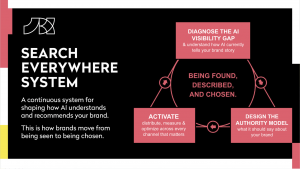
At Jan Kelley, we built our “Search Everywhere System” for exactly this problem: to help brands understand, strengthen, and scale their visibility across the places where buyers and AI systems form answers.
It connects SEO, AEO, GEO, content strategy, PR, social, analytics, reputation, and brand strategy into one operating model.
1. Diagnose the AI Visibility Gap
The first step is an AI Visibility Gap Analysis: a clear view of how your brand is being represented today, where authority is weak, and where competitors are gaining ground.
2. Design the Authority Model
We define the topics your brand needs to own, the proof points that support them, and the content architecture required to answer real decision-making questions across SEO, AEO, and GEO.
3. Activate (Distribute, Measure and Optimize the Signals)
We reinforce those authority signals across the channels that matter (from owned content and search to PR, communities, social platforms, reviews, and third-party source), measure where visibility is improving or breaking down, and adjust as search behaviour and AI systems evolve.
This work needs to be maintained, measured, and improved as search behaviour and AI systems evolve. It is a living system.
What This Means for Marketing Leaders
The rise of AI visibility is not another marketing trend. It is a structural shift in how discovery happens. It is also bigger than marketing. AI visibility can influence sales conversations, reputation, recruitment, partnerships, and how the market understands the business.
The brands that act now will have an advantage because authority compounds. The more consistently a brand is understood, cited, reviewed, discussed, and reinforced across channels, the easier it becomes for AI systems and buyers to recognize that brand as credible.
The brands that wait will face a harder problem later. They will not just need to improve rankings. They may need to correct misinformation, close authority gaps, rebuild trust signals, and regain visibility in places where competitors have already established relevance.
The encouraging part is that most organizations already possess many of the capabilities required to succeed. The challenge is connecting them. SEO, content, PR, social, analytics, and brand strategy are no longer parallel work streams. They are inputs into the same outcome and now have to work together towards the same goals:
Being found ➡ Being understood ➡And ultimately, being chosen.
Ranking still matters. But the bigger advantage will belong to brands that build authority wherever answers are formed.
Don’t Let AI Define Your Brand by Default
AI is already interpreting your brand, whether you are shaping that interpretation or not.
Jan Kelley’s Search Everywhere System helps brands understand how they are being represented, close authority gaps, and build the cross-channel signals needed to influence search, answer engines, and AI-generated recommendations.
Book a free AI Visibility Snapshot to see where your brand is visible, where it is vulnerable, and where competitors are gaining ground.
More Blog & Insights
 " alt="" loading="lazy" role="presentation" />
Automotive
 " alt="" loading="lazy" role="presentation" />
Automotive
It’s Time to End the Brand vs. Performance Debate (For Good)
When did marketing become a battle of brand versus performance?
Read Article " alt="" loading="lazy" role="presentation" />
Building Materials
5 Tactics to Better Understand Your Customers, Without the Guesswork
Many building materials brands will say they know their customers. And of course they do. They know their titles, roles and responsibilities. But knowing your customers isn’t enough to get selected. Understanding them is.
Read ArticleNever miss another blog post
Want to sign up for updates, announcements, offers and promotions from Jan Kelley? Simply fill in the form below and we’ll keep you up to date. You may later withdraw your consent at any time. Check out our Privacy Policy.