TL;DR
In home services, trust starts forming long before a technician arrives. Buyers assess credibility through dozens of small experiences: reviews, messaging, vehicle branding, financing language, website clarity, and perceived professionalism. Strong branding reduces perceived risk before the first interaction.
Home services purchases are rarely made in ideal conditions.
A furnace fails during a cold snap.
A basement floods after heavy rain.
An AC unit stops working during a heat wave.
A plumbing issue backs up onto the floor.
These decisions are often made quickly, under stress, and with limited information.
That kind of environment changes how people evaluate brands.
Many home services companies assume trust begins once a technician arrives or a salesperson explains the quote. Buyers will witness their brilliance and go from there.
But buyers have often already formed a perception of the company.
Trust starts much earlier.
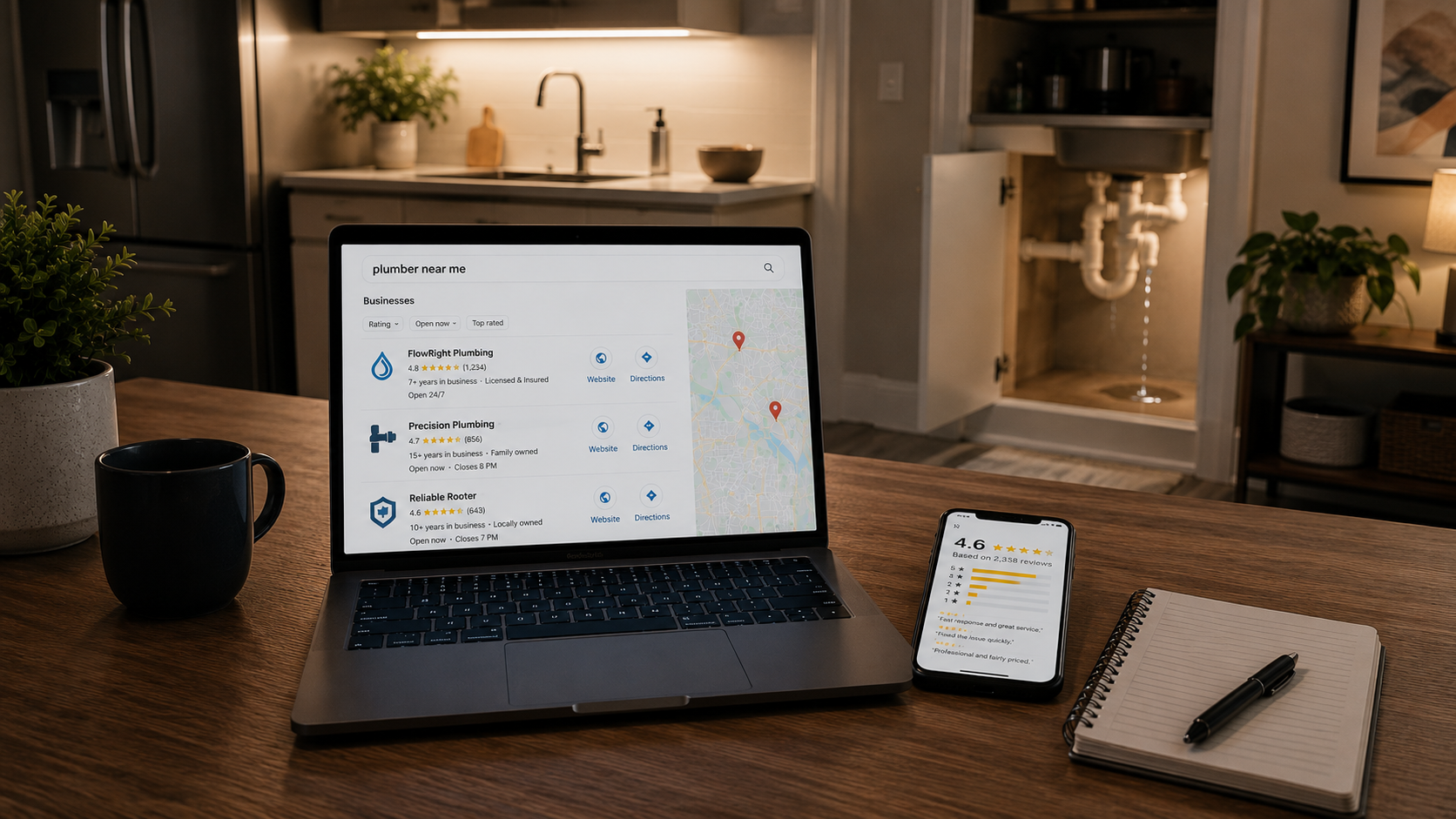
It starts when someone lands on your website at 11:30 p.m., trying to solve a problem.
It starts when they compare reviews across competitors.
It starts when they see your trucks in the neighbourhood.
It starts with how your company explains pricing, urgency, professionalism, and reliability before anyone speaks to a customer directly.
Homeowners are not just buying repairs or installations.
They are buying:
Underneath almost every home services decision is a quieter emotional calculation:
“Can I trust these people in my home?”
“Will I get ripped off?”
“Will this become a bigger problem?”
“Can I rely on them if something goes wrong later?”
Technical expertise matters, of course. But most buyers are not equipped to fully evaluate technical expertise before purchasing. Instead, they rely on trust signals to reduce uncertainty.
Not because branding makes companies “look good,” but because strong brands make people feel safer making decisions.
The challenge is that many home services brands communicate almost identically.
The same visual language.
The same smiling technician photography.
The same trucks.
The same messaging:
None of these claims are inherently wrong.
The problem is that nearly everyone says them.
Over time, categories drift toward sameness, instead of defining a distinct position.
The result:
Most buyers are subconsciously evaluating risk long before they submit a form or make a call.
Here’s where that trust is often built or lost.
#1. Website Clarity
A website is often the first operational experience a customer has with your company.
People are evaluating:
Confusing websites increase uncertainty.
Clear websites reduce it.
Even subtle friction signals can shape perception:
Professionalism is inferred through clarity.
#2. Reviews and Reputation
Consumers rarely expect perfection.
What they look for is consistency.
Reviews help buyers understand:
Ironically, overly polished reputation management can sometimes reduce credibility.
5 stars across the board can feel suspect and fake.
People trust brands that feel real, responsive, and accountable more than brands that appear artificially flawless.
In home services especially, buyers are searching for evidence that the company behaves predictably under pressure.
Also consider that some problems are ones customers can live with. If reviewers claim you’re fast and good but expensive, there are people who will be fine with that if it means their problem is solved. Conversely, if people say you’re slow, but good and affordable, there is a market who happily wait an extra day or two to get a better deal.
Consistency – not perfection – builds trust.
#3. Visual Professionalism
Trust is heavily influenced by perceived organization.
That shows up in:
Brands that appear organized feel lower-risk.
Not because customers consciously analyze branding systems, but because visual consistency signals operational consistency.
If the website feels disconnected from the trucks, or the technician experience feels disconnected from the advertising, trust weakens.
People notice fragmentation even if they cannot articulate it directly.
#4. Tone of Voice
How a company communicates shapes emotional perception quickly.
Does the brand sound:
In stressful situations, tone matters.
Overly aggressive urgency can increase anxiety.
Overly technical language can reduce confidence.
Overly generic messaging can make the company feel interchangeable.
The strongest brands communicate competence without amplifying fear.
#5. Financing and Transparency
Unexpected costs are one of the biggest emotional stressors in home services.
That means financing language, quoting processes, and pricing transparency strongly influence trust.
Hidden costs create anxiety.
Vague pricing creates hesitation.
Clear expectations create confidence.
Buyers do not necessarily expect cheap solutions.
They expect predictable ones.
Companies that communicate clearly about process, timelines, financing, and tradeoffs often feel safer, even when they are not the lowest-priced option.
Trust is not built by logos alone.
It is built through aligned experiences.
Brand strategy determines:
Without that strategic clarity, trust signals become inconsistent.
Marketing may position the brand as premium while service interactions feel transactional.
One region may feel polished while another feels disorganized.
Sales language may conflict with the website experience.
This is why branding in home services is operational, not just visual.
Consistency functions as infrastructure.
Strong brands reduce uncertainty by creating predictability across touchpoints.
And predictability is one of the strongest forms of trust.
Trust breaks when experiences fragment.
This becomes especially important for scaling or multi-location organizations.
One region feels premium.
Another feels rushed.
One technician experience feels consultative.
Another feels aggressively sales-focused.
Meanwhile:
Customers may not describe this as a “brand inconsistency problem.”
But they feel it.
And once trust feels unstable, every interaction becomes more fragile:
The strongest home services brands create operational alignment, not just visual consistency.
The strongest home services brands reduce uncertainty before the customer ever picks up the phone.
That changes:
In home services, branding is not cosmetic.
It is the system that shapes how safe, reliable, and predictable your company feels before the work even begins.
People don’t remember every detail of a quote.
They remember how uncertain or reassured they felt while making the decision.
That emotional residue shapes whether they move forward, leave a review, recommend the company to a neighbour, or call again years later.
 " alt="" loading="lazy" role="presentation" />
Building Materials
Building materials brands need to ensure they have determined the right objectives, chosen the right influencer to meet those objectives and can maintain their brand authenticity in the process. Here are 5 steps building materials brands can take to be successful with their influencer marketing program.
Read more " alt="" loading="lazy" role="presentation" />
Building Materials
There are risks when you focus your marketing efforts solely on lead generation. Learn what building materials brands can do to ensure lead gen success.
Read more " alt="" loading="lazy" role="presentation" />
Building Materials
Jeff Lancaster of the B2B Institute at LinkedIn shares some top B2B trends for contrarian marketers.
Read moreWant to sign up for updates, announcements, offers and promotions from Jan Kelley? Simply fill in the form below and we’ll keep you up to date. You may later withdraw your consent at any time. Check out our Privacy Policy.